Handcrafted, ultra-premium fertilizers for exotic, rare, and exotic plants.
Carnivorous Plant Serum vs Other Carnivorous Plant "Fertilizers"
Most products made for carnivorous plants start with plants.
We started with prey.
That is the difference.
A lot of products in this category are built around kelp, seaweed extracts, micronutrients, or general plant tonic ingredients. Those things may have a place in plant care, but they are not what carnivorous plants evolved to capture, digest, and absorb.
We are not here to insult kelp.
Kelp can be useful.
It just is not a fly.
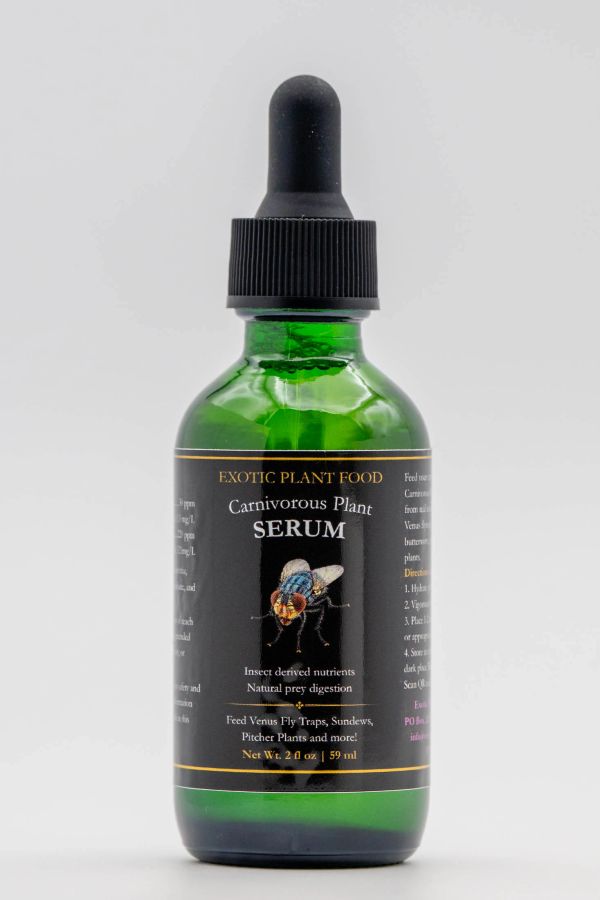
Carnivorous Plant Serum was developed around clarified insect-derived nutrients because carnivorous plants are built differently. Venus flytraps, sundews, butterworts, Nepenthes, pitcher plants, and other carnivorous species evolved to get nutrition from prey, not from rich soil or general-purpose fertilizers.
That is why this formula is different.
It is not a kelp tonic.
It is not a watered-down fertilizer story.
It is not generic plant food with a carnivorous plant label slapped on it like our "competitors."
It is prey-based nutrition for plants that feed differently.
Real Insects. Real Testing. Real Proof.
Carnivorous plants do not feed like ordinary plants.
In nature, they capture insects and absorb nutrients from their prey.
Carnivorous Plant Serum is made from a clarified insect-derived nutrient base and tested by a third-party laboratory. The tested sample showed measurable crude protein, nitrate nitrogen, potassium, and a small amount of reactive phosphorus.
The lab report showed:
Crude Protein: 8,321 mg/L
Nitrate Nitrogen: 30 ppm
Potassium: 220 ppm
Reactive Phosphorus: 0.13 mg/L
The sample was also screened for several metals and minerals, including arsenic, cadmium, lead, mercury, copper, zinc, calcium, magnesium, iron, manganese, and sulfate. These were reported as below detection limits in the tested sample.
This is prey-inspired nutrition made simple.
No kelp pretending to be prey.
No generic fertilizer story.
Just insect-derived nutrition for plants that evolved to eat differently.
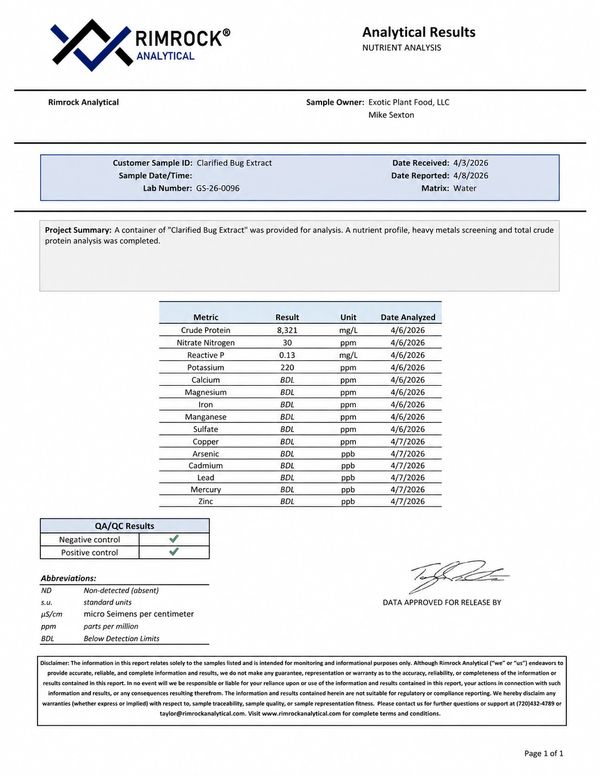
A picture is worth a thousand words. This one has lab results.
Carnivorous Plant Serum is made from a clarified insect-derived nutrient base, and this is the actual third-party lab report behind it.
We do not believe in hiding behind vague claims, mystery blends, or generic fertilizer language.
If we say it is prey-based, we should be willing to show the proof.
No kelp pretending to be prey.
No “trust us” science.
Just tested, insect-derived nutrition for plants that eat differently.